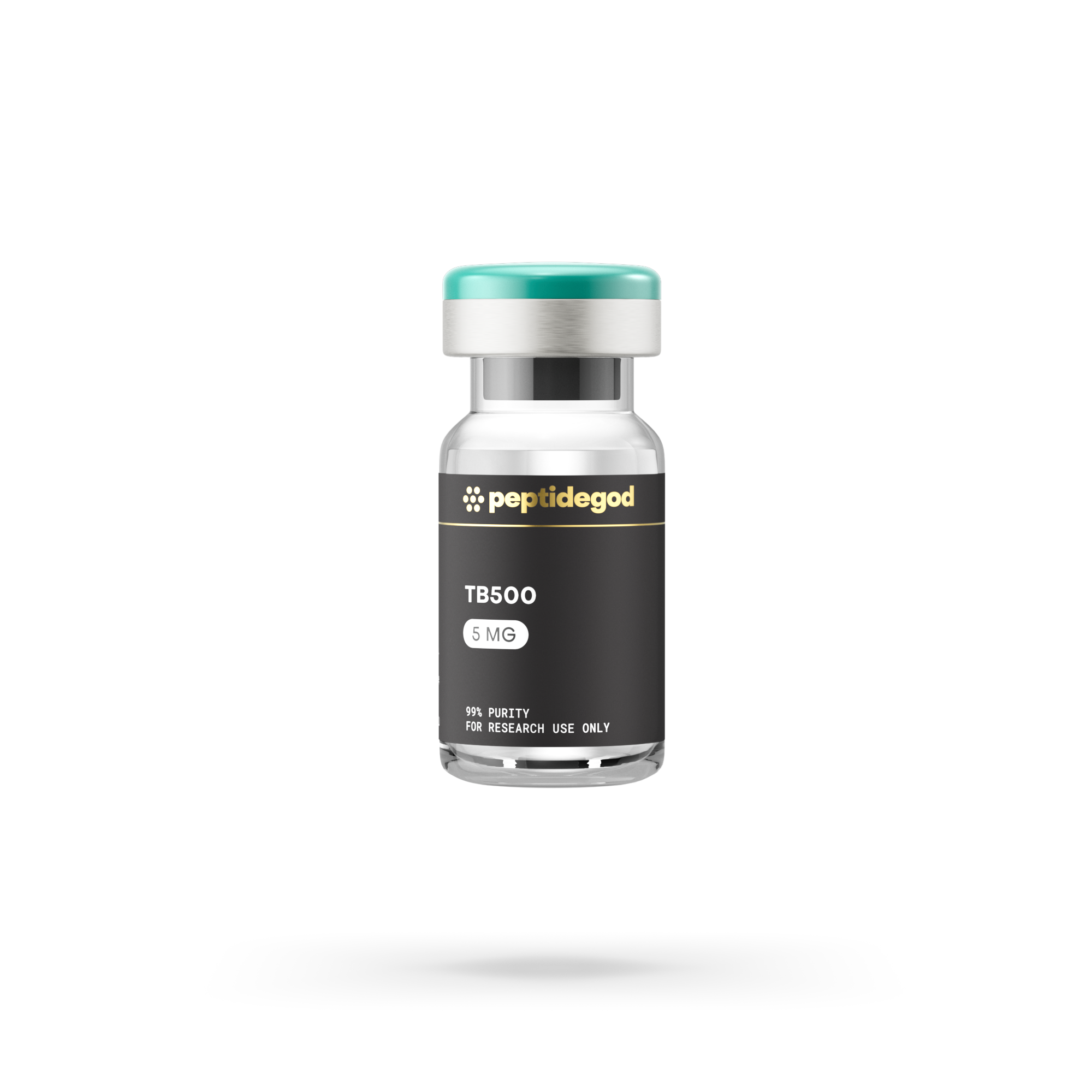
TB-500 (Thymosin Beta-4 fragment) lyophilized vial from Peptide God at $35.00.
PeptideGod TB500 Review
PeptideGod TB500 lyophilized vial reviewed for price, specifications, purity documentation and how it pairs with BPC-157 in stacking protocols.
Key Features
- $35.00
- price per vial
- 10 mg
- labeled peptide content
- $3.50/mg
- price per milligram
- 43
- amino acids in TB-500 (Thymosin Beta-4 fragment)
What's Inside
TB-500 is the active region of Thymosin Beta-4 (TB-4), a naturally occurring protein present in most human tissues. TB-4 plays a role in actin regulation, which governs cell structure and movement. By sequestering monomeric G-actin and modulating its polymerization into filamentous F-actin, TB-500 promotes the directional migration of repair cells, fibroblasts, endothelial cells, keratinocytes, into damaged tissue. A 2012 review in Annals of the New York Academy of Sciences summarized this mechanism across organ systems.
PeptideGod has not shown that TB-500 has a Certificate of Analysis on the product page. Reconstitute the solvent with bacteriostatic water and calculate the concentration as per our calculator.
How to Store and Handle
Keep the lyo powder in the unopened vial in a freezer at -20°C. Once reconstituted, store it in a refrigerator (2-8°C) and use it within 28 days. Cold chain procedure is valid for this product. For more details on temperature and light exposure, please visit our storage guide.
PeptideGod TB500 Overview
The TB-500 PeptideGod is a dry-state research vial containing the TB-500, a Thymosin Beta-4 synthetic fragment. It is available for $35.00 for 10 mg and is the only TB-500 product in the list of items, Real Peptides does not offer any TB-500 products currently. It is being researched for its effects on tissue healing and cell migration and is commonly used in conjunction with BPC-157.
Our Verdict
PeptideGod TB-500 is the only standalone TB-500 source in this directory. At $3.50/mg, the pricing is in line with their BPC-157 ($3.50/mg). Researchers specifically interested in TB-500's actin regulation and cell migration mechanisms need this product or the BPC-157 + TB-500 blend ($59.95). The lack of a displayed COA is the same limitation as other PeptideGod products. There is no COA-verified TB-500 alternative in this directory.
Our rating
TB-500 (Thymosin Beta-4 fragment) lyophilized vial from Peptide God at $35.00.
FAQ, PeptideGod TB500
What is TB-500?
TB-500 is a synthetic peptide derived from Thymosin Beta-4, a 43-amino-acid protein responsible for cell migration and tissue repair. Studies published on it indicate its efficiency in skin wound healing, corneal repair, heart tissue repair, and muscle healing in physical models.
How does TB-500 pair with BPC-157?
BPC-157 targets growth factor upregulation and blood vessel formation. TB-500 targets cell migration through actin regulation. The two mechanisms are complementary for tissue repair. PeptideGod sells a pre-mixed blend ($59.95) or you can buy each vial separately ($69.95 combined).
Does PeptideGod publish a COA for TB500?
No. PeptideGod does not display a Certificate of Analysis for TB-500 at the time of this review.
How much does PeptideGod TB500 cost?
$35.00 for a 10 mg vial, which equals $3.50 per milligram.